Our Process:
The Brighter Future Blueprint™
Helping our clients become more financially organized, confident, strategic, and secure.
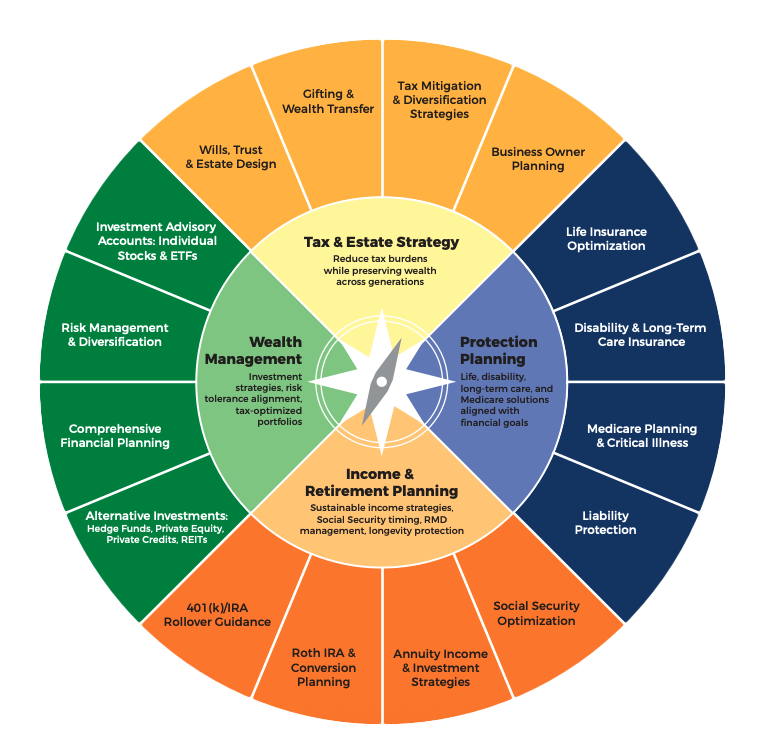
Your Path to Progress:
A Planning System Aligned with CFP® Standards
Why This System Works for You?
The Brighter Future Blueprint™ is a comprehensive financial planning system designed to provide clarity, confidence, and control over your financial future. Tailored specifically for medical and technology professionals, business owners, retirees, and families, this unified system combines structured analysis, clear methodologies, and personalized professional guidance that empowers you to:
Build strategic, long-term wealth that aligns with your life goals, providing financial stability and allowing you to live confidently today while securing your dreams for tomorrow.
Minimize taxes on current and future income, ensuring you keep more of your earnings and optimize your financial resources through proactive tax planning strategies.
Safeguard your hard-earned income, preserve your assets, and ensure lasting security and peace of mind for your loved ones through comprehensive risk management and tailored insurance solutions.
Support multigenerational financial goals by creating thoughtful and inclusive strategies that benefit both you and your family, bridging generational gaps and fostering a unified financial vision.
Empower your legacy with purpose and cultural values, ensuring your financial legacy is meaningful, impactful, and reflective of the traditions and principles that define you and your family.
When considering rolling over the proceeds from your retirement plan to another tax-qualified vehicle, note that you have options, including leaving the funds in your existing plan, or rolling it over to a new employer's plan. Depending on the option you select, there may be fees, expenses, and taxes upon withdrawal.
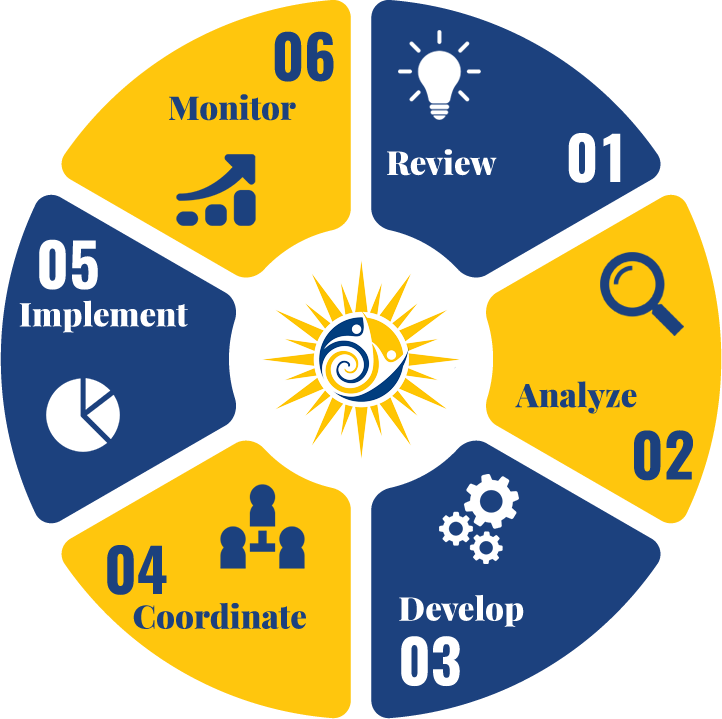
Our 6-Step Process
Step 1: Financial Foundations & Discovery
Outcome: Clear understanding of your current financial position
Experience a structured onboarding designed to make your initial steps easy and thorough. We'll begin by completing a comprehensive questionnaire, analyzing relevant documents, and understand your current or future cash flow needs to identify the important details of where you initially stand.
Establish your personalized eMoney financial planning dashboard, meticulously compiling key financial details including income, expenses, assets, liabilities, insurance policies, and estate documents. This step allows you to have a clear and simplified digital overview of your financial life, saving you time and energy moving forward.
Build the foundational layer of our custom Financial Planning Pyramid: focused on protecting against the "what-if" scenarios critical to an individuals or family's financial security. This includes identifying unexpected risks that may impact what you earn, what you own, what you owe, and those you love.
Step 2: Vision Mapping & Multigenerational Goal Clarity
Outcome: Define your personalized vision for a Brighter Financial Future™
Collaboratively identify and align your family’s financial priorities and objectives through thoughtful and meaningful conversations.
Clearly articulate and document personal and family goals such as retirement timelines, education and wedding planning, multigenerational support, philanthropic desires, and legacy intentions.
Transform your aspirations into tangible, achievable financial targets that provide you and your family with clarity, motivation, and direction.
Step 3: Strategic Analysis & Tax-Efficient Planning Strategies
Outcome: Identify strengths, gaps, and smarter paths to your goals
Conduct a thorough and insightful analysis of your existing financial strategies, identifying strengths, potential gaps, and opportunities for enhancement in investment portfolios, insurance coverage, and tax strategies.
Leverage our proprietary educational tools, such as the Three Tax Buckets, Insurance Types Chart, and Federal Tax Guides. We will also utilize eMoney’s Decision Center to illustrate the positive or negative impact of different strategies, and how small adjustments may have significant long-term value.
Develop customized, data-driven strategies aimed at maximizing tax efficiency, optimizing risk management, and accelerating your path toward achieving your defined financial goals.
Step 4: Brighter Future Blueprint™ Presentation
Outcome: Receive your clear, visual, actionable roadmap
Experience a personalized and engaging presentation of your Brighter Future Blueprint™, delivered digitally and in PDF format, clearly outlining actionable strategies, timelines, and progress indicators on your Financial Planning Pyramid.
Facilitate inclusive family sessions designed to bridge generational financial understanding, ensuring alignment and harmony with those who matter most to you.
Empower your decision-making with visual clarity and confidence, providing you with actionable insights and clear next steps.
Step 5: Implementation & Professional Coordination
Outcome: Efficient execution and seamless coordination
When you choose us to implement your financial plan, you will receive dedicated, hands-on support as we execute each aspect of your financial plan, from opening and funding accounts to reallocating investments, coordinating insurance needs, and updating beneficiaries.
Enjoy seamless professional coordination with your existing advisors—including CPAs, attorneys, realtors, mortgage consultants, insurance agents, and HR teams—or introductions to our vetted network of trusted professionals.
Experience clear communication, proactive updates, and meticulous follow-through, ensuring your plan is executed smoothly and efficiently, allowing you to remain focused on enjoying your life and doing what you do best.
Step 6: Monitoring, Adjustments & Generational Support
Outcome: Ongoing alignment and adaptability to life's changes
Benefit from regular, proactive plan reviews and real-time updates to your eMoney dashboard, ensuring your financial strategies remain optimized and relevant to market changes, legislative updates, and evolving personal circumstances.
Receive comprehensive annual support, including detailed cash flow management, mid-year tax strategy sessions, estate plan clarity, investment reviews, and insurance evaluations. Providing sustained clarity and confidence throughout your financial journey.
Gain continuous guidance and dedicated support through major life transitions—including college funding, job transitions, real estate transactions, selling a business, retirement, family caregiving, weddings, legacy planning, and managing inheritances—ensuring you and your family can thrive in every season of life.
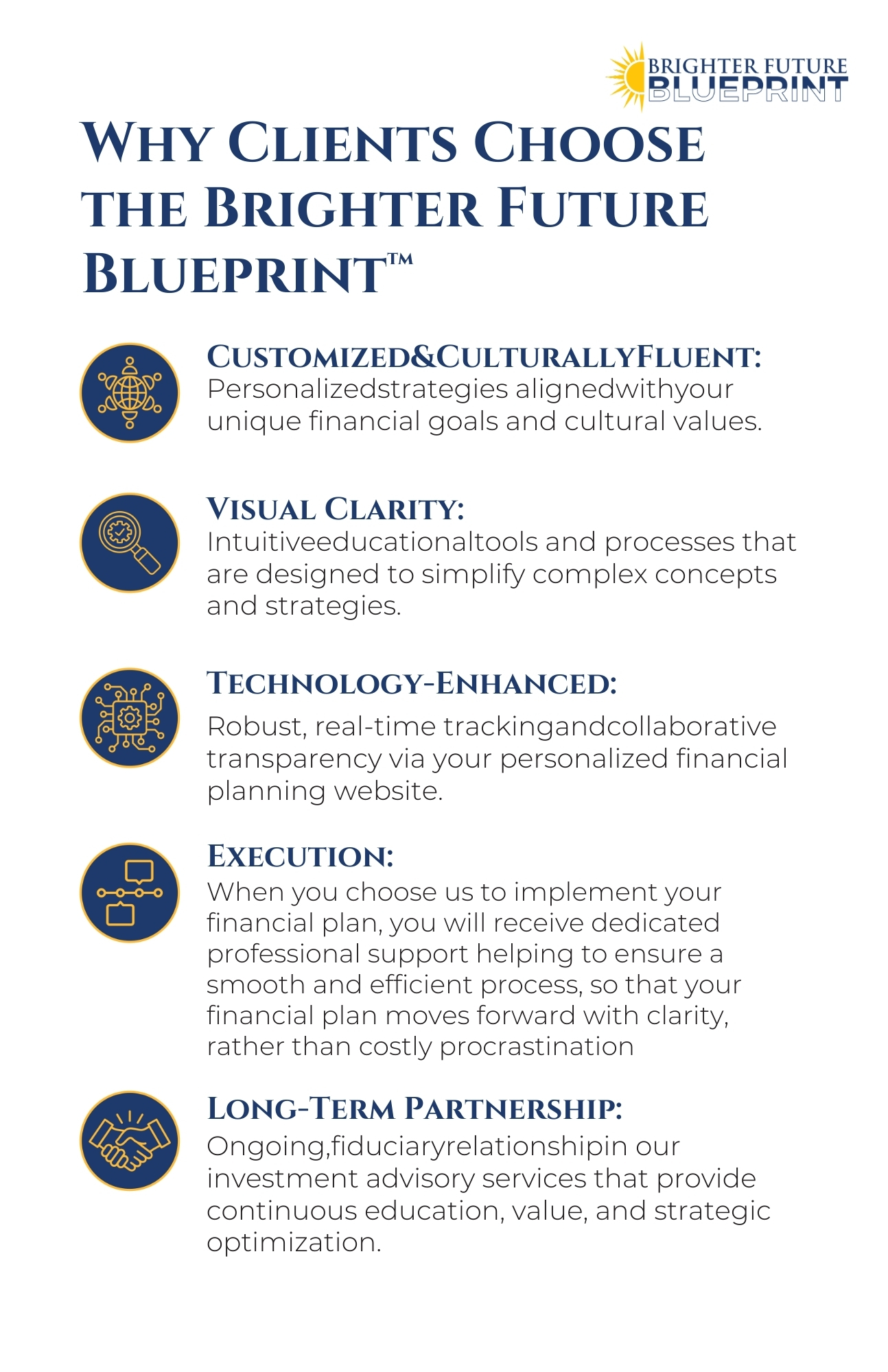
The Brighter Future Blueprint™ is more than a financial plan—it's a structured, CFP® aligned process designed to organize your finances, grow your wealth, reduce taxes, and protect your family. Supported by advanced planning tools, professional coordination, and educational resources, we help you achieve clarity today and confidence about your future.
Let’s begin building your Brighter Financial Future™ today.
Comprehensive Planning
Built Around You
Our role is to simplify complexity, act in your best interest in our investment advisory services, and create a strategy that empowers confident decisions for you and your family.
These are the primary topics and questions that shape your financial plan and lead to better decisions as we work together.
Goal Creation & Values
🎯 Vision & Values
What do you value most, or want more of, in your life?
What does financial independence mean to you personally?
How do you want your money to support your lifestyle today vs. in the future?
Have you discussed your goals with your spouse/partner to ensure alignment?
Do your goals reflect both your needs and your wants (essentials vs. dreams)?
📆 Timeline & Milestones
What short-term goals (1–3 years) are most important right now?
How do your medium-term goals (5–10 years) connect to your long-term vision?
Have you built flexibility into your goals to adapt to life changes?
What milestones can we celebrate along the way to stay motivated?
Are you on track to achieve your 1, 5, and 10+ year goals?
💸 Financial Integration & Trade-Offs
What’s worth saving for — and what should you prioritize?
Are your savings, investments, and insurance aligned with your stated goals?
Do you know the trade-offs between competing goals (e.g., paying for college vs. retiring early)?
How do taxes affect the path to achieving your goals?
Have you stress-tested your goals against risks like job loss, illness, or market downturns?
Who holds you accountable for staying on track with these goals?
🌍 Cross-Border & Global Goals
Do your goals involve living, working, or retiring abroad — and have you factored in tax and currency planning?
Are you balancing goals for family in the U.S. with commitments abroad (such as supporting parents in India)?
Have you considered how inheritance or real estate abroad fits into your long-term plan?
Are your estate and gifting strategies aligned with your global family goals?
👨👩👧 Legacy & Family
What kind of legacy — financial or otherwise — do you want to leave behind?
How do you want to support causes or communities that matter to you?
Are your children aware of your values and financial vision?
How do you want to spend your time, not just your money, in retirement?
Spending vs. Savings
💸 Cash Flow & Spending
Does your income truly support your lifestyle?
Do you know where your money is actually going each month?
Are you spending intelligently, and aligning your spending with your values and long-term goals?
How do you balance enjoying today with saving for tomorrow?
Are you and your partner aligned on spending and saving priorities?
🏦 Savings Structure & Liquidity
What percentage of your income should you save?
How much do you need for emergencies?
Should you maintain multiple “buckets” of savings (emergency, short-term, long-term)?
Where should you keep short-term savings (bank account, high-yield savings, CDs, T-bills)?
How much should you set aside for irregular but predictable expenses (home maintenance, travel, taxes)?
How much liquidity do you need versus keeping funds invested for growth?
Do you have a system in place to automate your saving and investing?
📈 Growth & Long-Term Investing
When does it make sense to shift from just saving to investing?
Are your savings invested in the right account types for tax efficiency (taxable, tax-deferred, tax-free)?
How should your savings strategy adjust as your income rises or your family grows?
Are you coordinating your savings with other goals like retirement, college, or buying a home?
💼 Business Owners & Cross-Border Planning
How do you manage irregular or variable income while still saving consistently?
Do you have a strategy for setting aside taxes, retirement contributions, and reinvestment in your business?
Are you protecting personal savings from business risk exposure?
If you’re sending money abroad (e.g., to family in India), how does that affect your U.S. savings plan?
Where should you hold savings if you anticipate living or retiring abroad?
Are your foreign savings accounts properly reported and integrated into your U.S. plan?
How do you protect savings against currency risk and inflation across borders?
👨👩👧 Lifestyle & Family Priorities
How much should you save for upcoming life events (weddings, education, relocation, elder care)?
How do you strike the right balance between saving for your children and securing your own retirement?
Have you considered how much you want to leave behind as a legacy vs. spend during your lifetime?
Debt Management
📊 Prioritization & Strategy
How do you prioritize which debt to pay down first?
Should you follow the “avalanche” (highest interest rate first) or “snowball” (smallest balance first) method?
How do you balance paying off debt with building an emergency fund?
Should you consolidate or refinance debt to reduce interest rates and simplify payments?
How do you evaluate “good debt” (mortgage, business loan) vs. “bad debt” (high-interest credit cards)?
How much debt is sustainable while still achieving your financial goals?
How do you become intentional and proactive with your debt and savings?
💵 Cash Flow & Trade-Offs
Should you be paying more toward debt, or saving and investing?
Is it smarter to pay extra toward debt or invest those dollars for long-term growth?
How do today’s interest rates change the math of debt repayment vs. investing?
Should you keep a mortgage for liquidity and tax efficiency, or pay it off early for peace of mind?
🎓 Student Loan Planning
Should you refinance or consolidate your student loans, and what’s the trade-off between federal vs. private?
Are you eligible for loan forgiveness programs, income-driven repayment plans, or employer assistance?
How does paying off student loans impact your ability to save for retirement or a home?
💼 Business & Cross-Border Debt
Should you use business debt strategically for growth, and how do you separate it from personal finances?
How do you structure debt (personal guarantees, lines of credit, SBA loans) to protect your family and assets?
When does leveraging debt for tax-deductible purposes make sense vs. being overly risky?
Should you prioritize paying down foreign loans before U.S. obligations (or vice versa)?
👨👩👧 Family & Lifestyle Considerations
How do you talk with your partner or family about managing debt together?
How much debt is it reasonable for parents to take on for a child’s education?
Have you considered the psychological vs. financial impact of carrying vs. eliminating debt?
Housing & Real Estate Decisions
🏡 Homeownership Decisions
Should you buy or continue to rent?
How much house can you afford without jeopardizing other financial goals (retirement, education, emergency fund)?
How do you determine your down payment?
What’s the total cost of ownership (insurance, taxes, maintenance), not just the mortgage payment?
💵 Financing & Mortgage Strategy
Should you consider a 15-year vs. 30-year mortgage, and how does that impact long-term wealth?
Should you use a fixed-rate or adjustable-rate mortgage (ARM)?
When should you refinance your mortgage?
Should you consider buying mortgage points to lower your interest rate?
When does it make sense to make extra principal payments vs. investing the money elsewhere?
How can you use a HELOC strategically (for liquidity, renovations, or investments)?
Is it smarter to pay off your mortgage early or keep it for leverage and liquidity?
📊 Real Estate as an Investment
How do you evaluate whether to buy a second home, vacation property, or rental property?
What are the tax implications of buying vs. selling your home (capital gains exclusion, SALT deduction limits)?
What are the tax benefits of real estate investing (depreciation, 1031 exchanges, opportunity zones)?
How does real estate fit into your broader portfolio and risk strategy?
🌍 Cross-Border Property Planning
If you own property in India (or abroad), what are the U.S. tax reporting and compliance requirements?
What are the U.S. tax implications of rental income or the sale of foreign property?
Should you hold foreign property in your own name, through family, or via a trust/LLC?
How do currency exchange rates impact foreign real estate decisions and repatriation of proceeds?
👨👩👧 Estate & Legacy Considerations
Should you title your home jointly, individually, or in a trust for estate planning efficiency?
Have you considered the impact of leaving real estate to heirs (step-up in basis, liquidity challenges)?
If your children may inherit property abroad, how should you structure ownership now?
Retirement Planning
🎯 Vision & Lifestyle
What does retirement mean to you — and what do you want your ideal day to look like?
What will your lifestyle be like, and how much will it cost?
Will you stay in your current home, downsize, or consider relocating (in the U.S. or abroad)?
💵 Income & Timing
How much money do you need to retire comfortably?
When can you realistically stop working, and how do you know you’re ready?
How will you replace your paycheck in retirement (Social Security, pensions, investments, annuities, rental income)?
When should you plan to take Social Security, and how can you maximize benefits?
⚖️ Taxes & Withdrawal Strategy
Which accounts should you draw from first — taxable, tax-deferred, or tax-free?
Should you consider Roth conversions before RMDs (Required Minimum Distributions) begin?
How will taxes affect your retirement income and your Social Security benefits?
🏥 Healthcare & Longevity
How will you cover healthcare costs before and after Medicare eligibility?
What are your options for Medicare Parts A, B, D, and supplemental plans?
How do you protect against the risk of outliving your money (longevity risk)?
📊 Risk & Investment Management
How should your investment strategy shift as you transition into retirement?
How do you protect against inflation reducing your retirement income?
What’s your plan for handling market downturns early in retirement (sequence-of-returns risk)?
🌍 Cross-Border & Global Planning
Do you plan to retire abroad, and how will that affect healthcare, taxes, and lifestyle costs?
How will currency exchange rates impact your retirement spending if you hold foreign assets?
👨👩👧 Family & Legacy
Do you want to leave a financial legacy, or focus on spending during your lifetime?
How does your estate plan integrate with your retirement income plan?
Should you use retirement accounts for charitable giving (Qualified Charitable Distributions, donor-advised funds)?
Are your beneficiary designations aligned with your retirement and estate goals?
Investment Strategies
📊 Core Strategy & Diversification
What should your investment strategy look like based on your goals, timeline, and risk tolerance?
Are you investing for growth, income, preservation, or a combination?
How do you know if your portfolio is properly diversified across asset classes and geographies?
Should you focus on individual stocks, mutual funds, ETFs, or a mix of vehicles?
⚖️ Risk & Market Behavior
How much risk is appropriate for your situation, and how do you balance risk with opportunity?
Do you have a plan for market volatility so emotions don’t derail your goals?
How often should you rebalance your portfolio to stay on track?
Are you prepared for both the upside and downside of your investments?
💵 Tax Efficiency
Are you taking advantage of tax-efficient placement across taxable, tax-deferred, and tax-free accounts?
How do capital gains taxes affect your investment choices?
Are you harvesting gains or losses strategically to reduce taxes?
Do you understand the difference between short-term and long-term capital gains treatment?
🧓 Retirement Integration
Are your investments aligned with your retirement income strategy?
Should you prioritize Roth or Traditional accounts for future withdrawals?
How will dividends, interest, and RMDs affect your retirement cash flow?
Are you planning for sequence-of-returns risk in retirement?
🌍 Cross-Border & Global Investing
Do you own foreign investments, and are you aware of their U.S. tax treatment (such as PFIC rules)?
How should you invest if you plan to retire abroad or support family overseas?
How do currency fluctuations impact international investments or global real estate?
Are your foreign accounts and investments compliant with U.S. reporting (FBAR, FATCA, Form 8938)?
👨👩👧 Legacy, Values & Alternatives
Should your investments be titled individually, jointly, or in a trust for estate efficiency?
How do you align your investment plan with education funding or multi-generational goals?
Are your investments structured to provide for heirs in a tax-efficient way?
How do charitable strategies like DAFs or CRTs integrate with your portfolio?
Should you consider alternatives such as real estate, private equity, or hedge funds?
How much, if any, should be allocated to alternatives versus traditional markets?
Are you interested in ESG or values-based investing, and how does that impact performance and taxes?
How do you evaluate crypto and other emerging assets within a fiduciary framework?
Insurance & Risk Management
🛡️ Life Insurance
Do you need coverage beyond what your employer provides?
Should you choose term, permanent (Whole, UL, VUL), or a mix of both?
What type and amount of coverage best fits your family and goals?
Is life insurance for income replacement, estate liquidity, business succession, or tax-free retirement income?
When was your coverage last reviewed to ensure it still fits?
Should your policy be owned individually, jointly, or in a trust (ILIT)?
How do you decide which company is right for you?
💼 Disability Insurance
Would your family be financially secure if you couldn’t work for an extended time?
Do you understand “own-occupation” vs. “any-occupation” coverage?
Are your employer benefits enough, or do you need supplemental coverage?
How are disability benefits taxed depending on who pays the premiums?
🧓 Medical, Long-Term Care & Health Coverage
Medical Insurance
Stay with employer coverage or explore private plans?
Are you using HSAs or FSAs for tax savings?
Should you pick a high-deductible plan or traditional PPO/HMO?
What happens to coverage if you change jobs, retire early, or lose employer benefits?
If self-employed, what’s the most cost-effective way to insure your family?
How does living or traveling abroad affect your U.S. health coverage?
🏠 Property & Casualty Insurance
Is your homeowners or renters coverage sufficient?
Is your auto policy adequate beyond state minimums?
Do you have protection for valuables like jewelry, art, or collectibles?
How often should you review and update property & casualty coverage?
⚖️ Liability Protection
Do you need an umbrella policy for extra liability protection?
How much coverage is enough given your assets and net worth?
If you own rental property, do you have the right liability protection?
Should you use trusts, LLCs, or insurance to separate business and personal risks?
👩💼 Employee Benefits
Are you maximizing employer benefits such as group life, disability, and health insurance?
Do workplace health plans, HSAs, or FSAs integrate with your personal strategy?
Should you consider supplemental coverage outside of work?
Are you optimizing equity benefits like stock options, RSUs, or ESPPs tax-efficiently?
As a business owner, are you offering benefits that attract and retain talent?
🌍 Business & Cross-Border Planning
Do you have key person or buy-sell insurance for your business?
Can insurance support your succession or continuity plan?
Are you maximizing tax benefits through executive or retirement plans?
Should life insurance be owned in a U.S. trust to simplify global estate planning?
Loans against your insurance policy accrue interest and decrease the death benefit and available cash surrender value by the amount of the outstanding loan and interest. Accessing cash value will reduce the available cash surrender value and death benefit.
Tax Planning Strategies
📊 Income & Bracket Management
Are you taking advantage of all available tax savings opportunities?
Are you strategically managing income to stay in a lower tax bracket?
Have you considered bunching deductions or accelerating income/expenses to optimize taxes?
Are you timing capital gains and losses to minimize your tax liability?
Are you thinking beyond short-term tax savings to build strategies for decades to come?
🧓 Retirement & Distribution Planning
Does a Traditional or Roth IRA make more sense for your situation?
Should your 401(k) contributions be pre-tax or Roth, and in what proportion?
What are the tax implications of your current and future retirement income?
Are you planning Roth conversions before Required Minimum Distributions (RMDs) begin?
Do you understand how Social Security benefits are taxed, and how to reduce that burden?
Are you aware of what assets in your portfolio are taxed now, taxed later, and tax-free?
💼 Business Owner Strategies
What are the implications on your taxable income as an employee versus as a business owner?
Have you considered whether an S Corporation or LLC structure could reduce your taxes?
Are you maximizing retirement plan options for business owners (Solo 401(k), SEP IRA, or Cash Balance Plan)?
📈 Investments & Real Estate
Do you know which investments should be held in taxable, tax-deferred, or tax-free accounts (asset location)?
Are you harvesting gains during low-income years to reset cost basis?
Are you leveraging real estate tax benefits such as depreciation, 1031 exchanges, or opportunity zones?
🌍 Cross-Border & Global Planning
Are you properly reporting and optimizing foreign accounts (FBAR, FATCA, Form 8938)?
Estate Planning
📜 Core Documents & Probate
Are you aware of the downsides of probate and how to avoid it?
Do you have a valid Will, Powers of Attorney, Living Will, and Revocable Living Trust — and do they make sense for your situation?
If you have minor children, have you established guardianship provisions?
When was the last time your estate documents were reviewed or updated?
⚖️ Taxes & Advanced Strategies
Do you currently have, or are you projected to have, a state or federal estate tax issue?
Have you considered an ILIT (Irrevocable Life Insurance Trust) to reduce estate tax liability?
Have you explored advanced wealth transfer tools such as GRATs, SLATs, or Family Limited Partnerships?
Are you coordinating your estate plan with your retirement and tax planning to minimize lifetime taxes and maximize legacy?
👨👩👧 Family Dynamics & Protection
Have you coordinated beneficiary designations across retirement, insurance, and brokerage accounts to avoid conflicts with your will or trust?
Do you understand the difference between revocable and irrevocable trusts, and when each is appropriate?
Have you considered using trusts to protect children’s or grandchildren’s inheritances from divorce, creditors, or poor money management?
If you have a blended family, have you structured your plan to balance fairness and clarity?
Have you discussed your estate plan with your heirs to minimize conflict?
🛡️ Coordination & Risk
Have you considered how to protect your assets from lawsuits or creditors?
Does your estate plan account for potential long-term care costs, and should insurance be part of the strategy?
🌍 Cross-Border & Global Planning
Do you have heirs or assets outside the U.S., and are you aware of the risk of double taxation?
Have you considered U.S. trust structures to simplify inheritance for non-U.S. heirs?
Have you structured your plan so foreign accounts and property are properly reported and transferred?
🌟 Legacy Beyond Money
Is charitable giving part of your estate planning goals?
Have you determined how assets will be distributed between family, government, and charity?
Does your estate plan include provisions for digital assets such as social media or online accounts?
Have you documented your values, wishes, or family history as part of your legacy, beyond money?
Education Planning
🎯 Saving Goals & Timing
How much should you be saving for college?
How do rising tuition costs impact long-term savings goals?
When should you start saving for your child’s education?
Should you prioritize retirement savings or college savings first?
💵 Funding Options & Flexibility
What are the benefits and limitations of 529 plans?
Are there other ways to fund a college education besides 529s?
How do scholarships, grants, and financial aid factor into your planning?
What happens if your child doesn’t use the funds for education?
How should you invest education savings based on your child’s age?
⚖️ Taxes & Policy Changes
How do tax benefits differ between 529 plans and other savings vehicles?
How do recent tax law changes affect education planning?
👨👩👧 Family Dynamics & Estate Planning
Should grandparents contribute directly to 529 plans or gift money another way?
How does education funding intersect with estate and gift tax planning?
How do you balance saving for multiple children with different ages and goals?
What strategies should you use if a child receives a scholarship — how do you reallocate funds?
There are fees, charges and tax ramifications associated with a 529 plan, and the underlying investment options are subject to market risk and will fluctuate in value. Be sure to read the full prospectus of the 529 plan you decide to purchase.
Small Business Owner Planning
💼 Business Structure & Taxes
Is your current business structure (LLC, S Corp, C Corp, Partnership) the most tax-efficient for your situation?
Are you maximizing deductions, credits, and the Qualified Business Income (QBI) deduction?
Should you separate personal and business assets more strategically for tax and liability purposes?
🏦 Retirement & Benefits
What retirement plan is best for you and your employees (Solo 401(k), SEP IRA, SIMPLE IRA, Defined Benefit, or Cash Balance Plan)?
How do you balance business reinvestment with personal retirement savings?
Should you consider offering employee benefits (health, retirement, group insurance) to attract and retain talent?
🛡️ Risk Management & Insurance
Do you have the right business insurance (liability, key person, errors & omissions, workers’ comp)?
Have you protected the business from the loss of a key employee, partner, or owner?
Should you use life or disability insurance inside your business to fund buy-sell agreements or protect cash flow?
📊 Cash Flow & Growth
How much of your profits should be reinvested vs. distributed to you personally?
Do you have access to the right financing (lines of credit, SBA loans, business loans) without overleveraging?
How do you manage cash flow during seasonal or uneven income cycles?
🔄 Succession & Exit Planning
What’s your plan for eventually selling, transferring, or exiting the business?
Do you have a buy-sell agreement in place with co-owners or partners?
How do you determine the value of your business for succession, sale, or estate purposes?
Have you coordinated your personal financial plan with your business exit strategy?
🌍 Cross-Border & International
If you own a business in India (or abroad), are you aware of the U.S. reporting and tax implications?
How do cross-border entity structures impact taxes, cash flow, and liability?
Are you properly managing currency and repatriation risks when moving money between your U.S. and foreign businesses?
How do U.S.–India tax treaties apply to your business income?
👨👩👧 Family & Legacy
How do you protect your family if most of your wealth is tied up in your business?
Will your children be involved in the business, and if so, how do you transfer ownership fairly?
How does your business integrate into your estate plan (trust ownership, gifting strategies, estate tax reduction)?
Are you balancing business goals with your personal and family financial goals?
This Process Helps You Become:
More confident
You will understand your financial life clearly and make decisions with greater certainty instead of doubt.
More strategic
Your wealth can grow with intention and better support your long-term goals.
More organized
We bring structure to your accounts, investments, and planning so everything is connected and efficient.
More protected
Your family, income, and future can be shielded from unnecessary risk.
More tax-efficient
You will keep more of what you earn by using smart strategies that match your situation.
More in control
You will know exactly where you stand, what is working, and what needs attention.
More aligned with your values
Your money will support the life you want to build instead of creating stress or confusion.
More at peace
You will feel more secure knowing your plan is monitored, updated, and moving in the right direction.

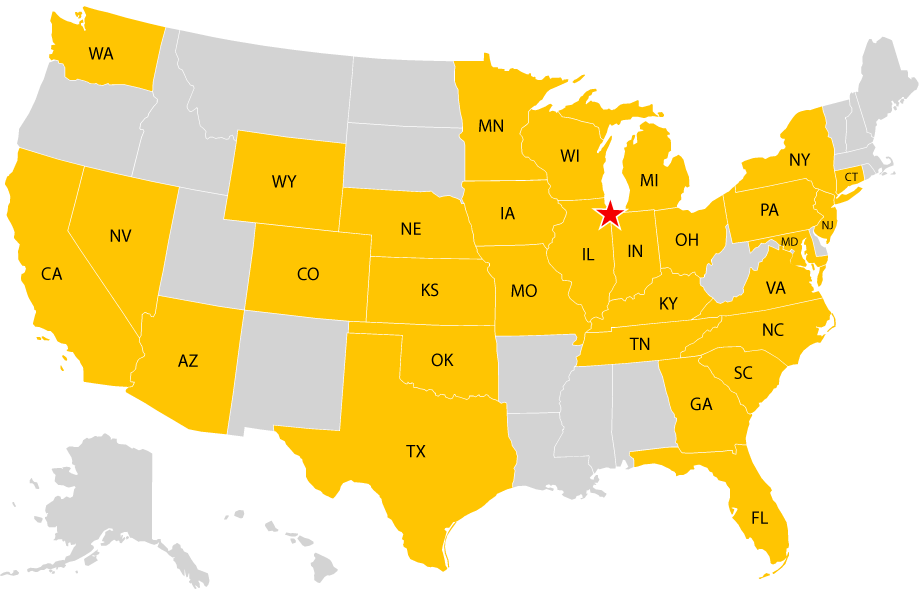
Where We Do Business